
Advancements in CNC turning and milling for high-precision manufacturing have significantly reshaped the standards in modern and evolving manufacturing. Plus, potential production facilities with reduced costs and effective operation.
With the help of these technological developments, various industries, such as aerospace components and medical devices, are utilizing high-performance automotive CNC for improved and more precise operations.
Moreover, advancements in CNC have enabled exceptional precision, high speed, and consistency through innovative and pre-programmed processes, which are crucial for today’s competitive and challenging marketplace.
In this article, we are going to explore various Advancements in CNC and how they impact high-precision manufacturing through intelligent and automated operations.
Core Objectives of Advancements in CNC
Before delving deeper, let’s enumerate the considerable advancements in CNC. The most important ones are:
- Enhance machining performance and precision
- Minimize operational costs and setup times.
- Declining error and delays in complex processes.
- Accelerate production and time-to-market
These advancements require the seamless integration of software and hardware, working closely together to create an unparalleled synchronization between design input and machining output.
One of the most critical elements of working in high-precision manufacturing is maintaining control over dimensions, surface finish, and tolerances, while striking a balance among them. Which is now possible advancements in CNC by offering:
- Real-time feedback systems
- Advanced sensor networks
- AI-enhanced machining algorithms
These intelligent systems are designed to:
- Detect tool wear and thermal deviation
- Adapt parameters such as feed rates and speeds dynamically to optimize performance.
- Maintain uniform quality with minimal human supervision.
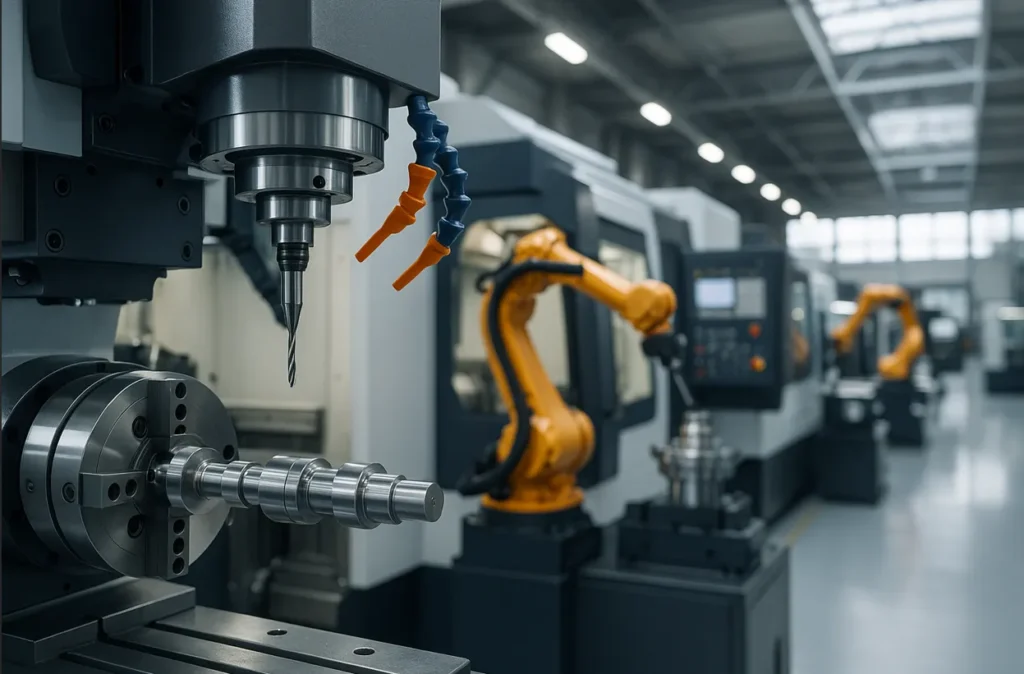
Advancements in CNC Turning
Being able to manage a large operation and multitasking within a single structure is one of the most significant advancements in CNC turning, which has led to the widespread adoption of multi-axis turning centers.
Simultaneous movements and activities among multiple axes enabled CNC to conduct complicated and high-profile operations in a single setup, leading to several benefits for diverse industries such as aerospace, medical equipment manufacturing, and satellite and defense systems, including:
- Enhanced focus and precision due to fewer repositioning steps
- Significantly reducing lead times.
- The capacity to machine complex geometries and contours
Innovations Leading to CNC Milling Advancements:
CNC milling is a subtractive manufacturing process that shapes a solid workpiece into various desired shapes using rotary cutters to remove material from it.
It’s an exact process with close attention to detail and versatile operations, known for its significant role in producing elements with intricate geometries, tight tolerances, and complex surface features.
It is through CNC milling that high-speed production with fewer errors and a clean outcome is possible, especially in sensitive industries such as aerospace, medical, and electronics manufacturing. CNC milling processes have offered remarkable innovation and transformation, especially with the introduction of:
- High-speed machining (HSM)
- Ultra-precision spindles
- Advanced coolant systems
- Improved cutting tool materials (e.g., carbide, PCD)
These innovations are designed to help manufacturers with high-volume production and enable:
- Machining of hard-to-cut materials like titanium and ceramics
- Quicker material removal rates without affecting tool life or surface finish
- Improved outcomes in delicate or highly detailed workpieces
The Role of Digitalization in Advancements in CNC
Besides milling, digitalization is also required for faster and more accurate production. With the help of digital tools, manufacturers can visualize and optimize the material cut process before the actual operation, offering numerous benefits such as reduced scrap rates, fewer physical prototypes, and a short developmental cycle. These innovations in digitalization are possible by:
- CAD/CAM integration for smoother design-to-manufacturing workflows
- Digital twin modeling to simulate real-world performance
- Toolpath simulations to avoid collisions and inefficiencies
Smart Manufacturing and Industry 4.0 Integration with CNC Advancements
The integration of CNC and Industry 4.0 has led to several transformations and the emergence of new smart manufacturing through cloud-based machine monitoring, machine learning for process optimization, and predictive maintenance tools, helping to:
- Expand machine lifespan
- Improve in precision and repeatability
- Transform traditional CNC machines into intelligent, self-correcting, and smart systems.
Sustainability Benefits of Modern CNC Turning and Milling
Modern CNC turning and milling have also significantly contributed to sustainability and overall environmental safety, reducing ecological damage through more efficient and precise use of raw materials. Some of the sustainability advantages include:
- Less waste and debris due to tighter tolerances
- Optimized energy consumption during machining cycles
- Enhanced tool life, which reduces overall consumption of consumables and resource-limited materials
Summary of Key Benefits
Let’s shortly outline the key benefits offered by advancements in CNC turning and milling for high-precision manufacturing:
- Excellent accuracy and consistency
- Higher production rate and reduced cycle times
- Flexibility to produce complex and multi-surface parts
- Reduced setup and manual intervention by multi-axis
- Lower material waste and energy use
- Improved adaptability through simulation and AI tools
Conclusion: The Road Ahead for High-Precision CNC Machining
The continuous evolution of CNC turning and milling technologies has significantly transformed the production cycle, making them a crucial strategy for manufacturers navigating the digital era.
Advancements in CNC turning and milling have enabled intelligent automation, digital production, sustainable operational practices, and data-driven insights for manufacturers. CNC developments will continue to contribute to perfection and precision in production and operations across various industries.

Leave A Comment